
Stop Letting Hotel Contracts Gamble With Your Conference Budget
Most conferences don’t get wrecked by “high prices.”
They get wrecked by what’s already in the contract.
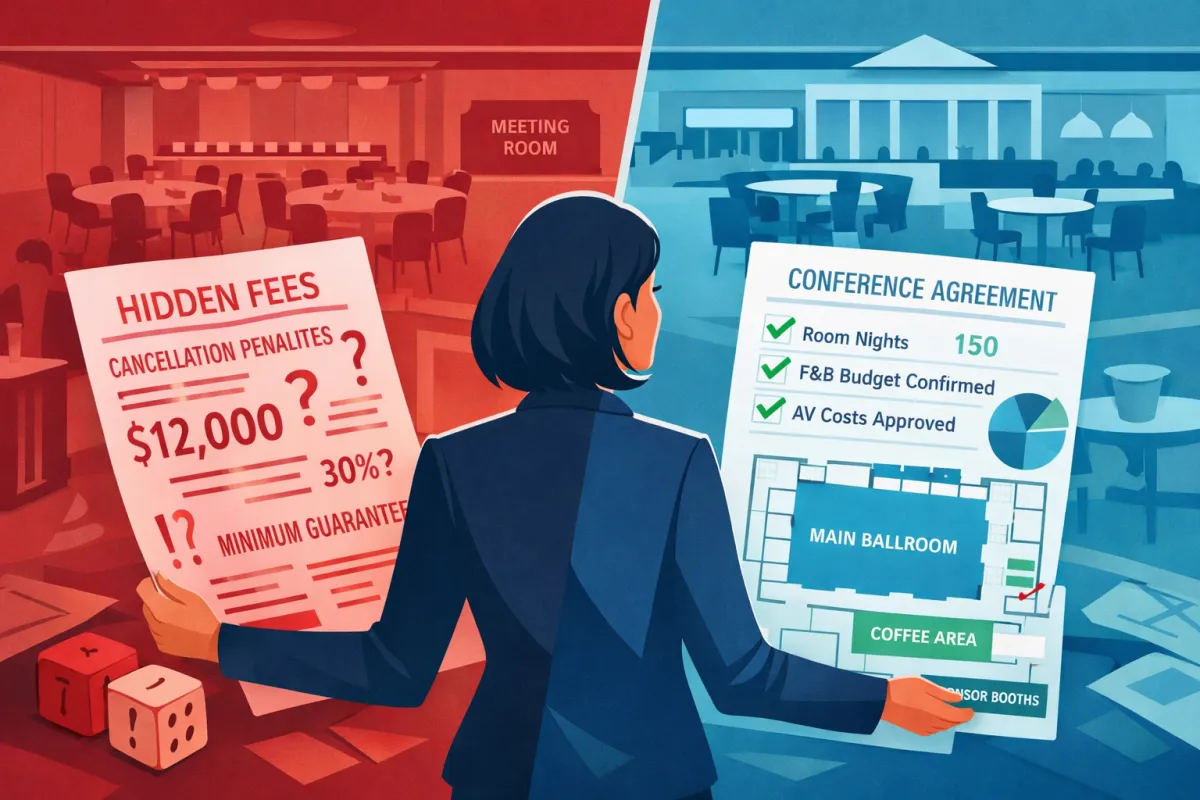
You think you’ve negotiated a solid deal. The rates look fine. The dates work. Everyone signs. Then the final bill lands and you’re staring at five‑figure attrition penalties, F&B minimums you barely hit (or miss), and surprise “required” AV or Wi‑Fi fees. At that point, you’re not running a strategy. You’re doing damage control.
The fix isn’t learning to argue harder in the ballroom. It’s changing the math and structure you walk into negotiations with.
Decide Your Line Before You Ever Talk To a Hotel
If you walk in saying, “What can you do for us?” you’re already on the back foot.
Before you send an RFP or go on a site visit, you want three numbers: your financial goal for the event (profit, true break even, or “we’re willing to invest up to $X”), your maximum acceptable loss, and a realistic range for attendance and sponsorship. From that, you back into a rough F&B range and room block that actually fit your model.
Now the contract is a test: does this venue fit inside the math we can live with? Not, “Can we rationalize this and hope?”
Make Room Blocks and Attrition Work On Your Terms
Everyone’s heard “attrition is a penalty if you don’t fill the block.” The pain comes from the details you didn’t negotiate.
You want attrition calculated cumulatively over the whole stay, not night by night. Night‑by‑night means you can get penalized even when total pickup is strong, just because one shoulder night was soft. Cumulative gives you room to breathe across the pattern.
Then sanity‑check the percentages against your history instead of the hotel’s wish list. If you’ve never hit 90 percent pickup on shoulder nights in your life, don’t sign 90 percent on paper “because it’s standard.”
Finally, protect yourself with language that forces the hotel to try to resell unused rooms before charging you, and credits any attendee who books outside the block back to your totals. You’re not being combative; you’re stopping a quiet double‑dip where the property gets paid twice for the same room.
Turn F&B Minimums From Vibes Into Math
“$80,000 F&B minimum” sounds like a lot or a little depending on who’s in the room. Turn it into per‑person math so you’re arguing with numbers, not feelings.
If your minimum is $80,000, service and tax add roughly 30–40 percent, and you expect 400 people on site, you’re looking at around $260–$280 per person across the event. Now you can design menus and break structure to land close to that number instead of throwing darts.
You also want clarity on what counts toward the minimum. In many contracts, service and tax do not. That means the “$80K” is just food and beverage; the add‑ons are extra. Confirm it in writing. Then look at trades: often you can raise your F&B commitment slightly to eliminate or reduce meeting room rental. Sometimes that’s smart, sometimes it isn’t. The point is you’re running the math now, not discovering it in the invoice.
Lock AV and Internet Flexibility Up Front
The tech language is where a lot of your margin quietly disappears.
On meeting space, get specific rooms and times in writing for general sessions, breakouts, expo, and offices. “Space as available” is not a plan.
On AV, avoid blanket “must use in‑house for everything” clauses if you can. At minimum, you’re negotiating the right to bring in your own streaming and recording hardware, reasonable patch fees instead of a percentage of your total AV spend, and clarity on what in‑house supervision actually costs.
On internet, you want three lanes defined: attendee Wi‑Fi (flat rate and expected performance), staff/ops network (separate and stable enough to run registration and scanning), and dedicated hardlines for any rooms that stream. One vague paragraph here can eat a shocking amount of profit later.
Use a Checklist So You Don’t Pay Tuition Twice
Trying to “remember everything” in a 20‑page hotel contract is how planners pay the same tuition every year.
You want a repeatable checklist for city and venue selection, room block and attrition terms, F&B math, AV and internet clauses, and cancellation and rebook language. Run every contract through the same lens, and your downside stops being a mystery. You’re not hoping the hotel is fair; you’re operating from a playbook.
If you don’t want to build that from scratch, that’s literally what the Flawless Conference Playbook is: city and venue questions, contract checklists, and the exact clauses to push for so your event isn’t profitable “if everything goes right,” it’s protected even when things don’t.
